
Air Conditioning Repair in London & the South East
When a system stops working it is usually one of a handful of things, and the difference between a half-hour fix and a new unit is worth knowing before anyone starts quoting. HT Cooling repairs domestic, commercial and industrial air conditioning across Surrey, Berkshire and London, on equipment from any manufacturer, whoever installed it. Every engineer who works on refrigerant is F-Gas registered and the company holds F-Gas certificate 2004080.
What has usually gone wrong
It runs but does not cool
The most common call, and most often refrigerant charge. The system has lost gas somewhere, so it keeps running while cooling less and less. Topping it up on its own is not a repair — the gas went somewhere, and it will go there again. The leak has to be found and fixed first.
It cools, then stops, then starts again
Short cycling. Often a blocked filter or coil making the unit overheat and shut itself down to protect itself, sometimes a control or sensor fault. Cheap to fix early, expensive to ignore, because the compressor takes the punishment.
Water coming from the indoor unit
Almost always the condensate drain — blocked, badly fallen, or a failed pump. It is the fault most likely to damage a ceiling, and the one most often caused by a system that has never been serviced.
Noise that was not there before
A rattle is usually a loose panel or fan guard. A grinding or screeching sound from the outdoor unit is a bearing or a fan motor, and it is worth switching off and calling rather than running it to failure.
Nothing happens at all
Power supply, isolator, control board or a tripped protection device. Before booking, it is worth checking the isolator switch and the consumer unit — occasionally that is the whole answer, and we will tell you so.
What we do on a repair visit
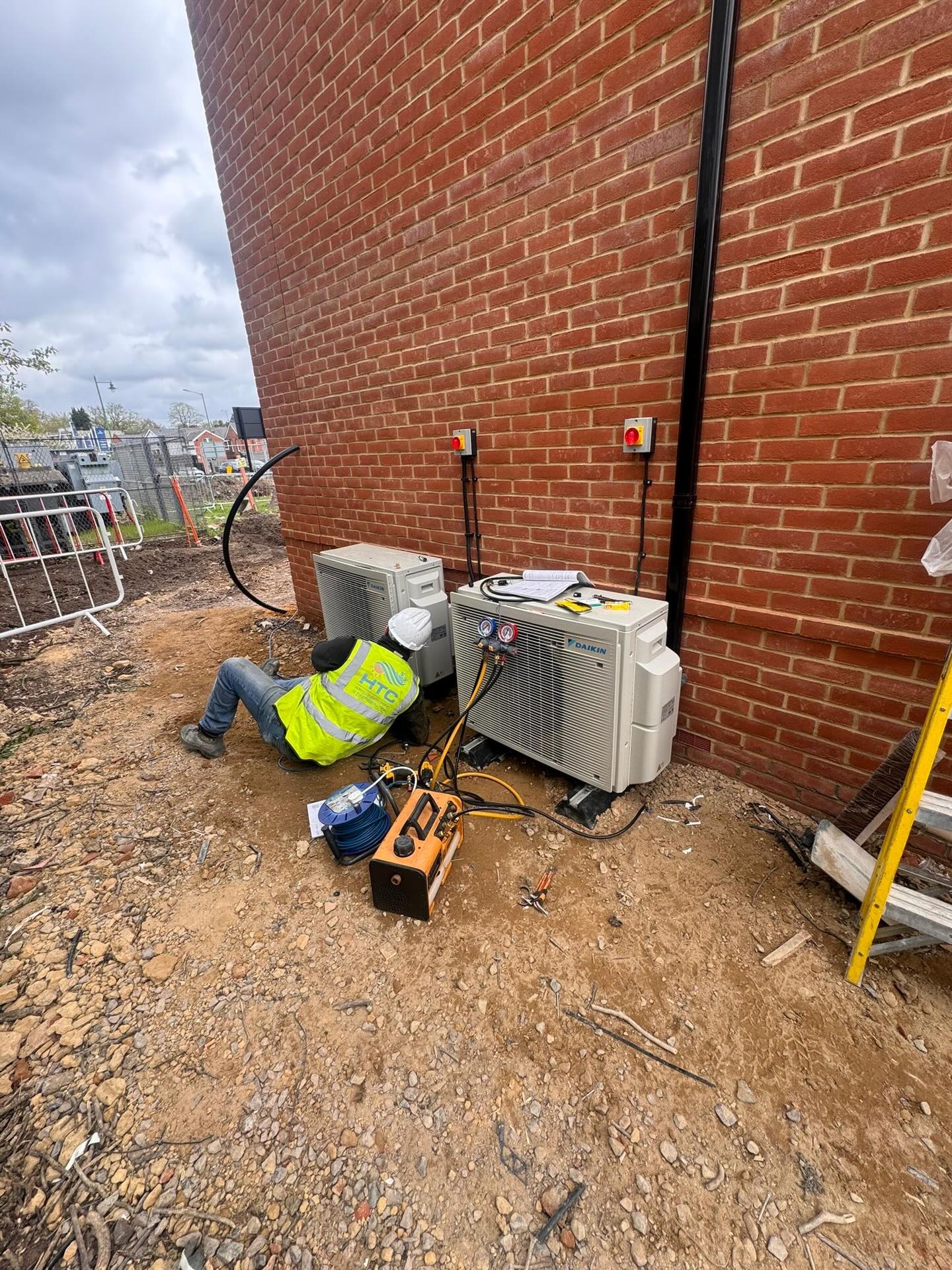
We diagnose before quoting. That means measuring pressures and temperatures and testing electrically, rather than replacing parts in hope. You get told what is wrong, what it will cost to put right, and — if it is borderline — whether we would spend the money.
Where refrigerant has been lost, we trace the leak, repair it, and only then recharge. Where a part has failed, we source it and quote before fitting. If a system is beyond sensible repair, we will say so rather than sell you a repair that buys a fortnight.
Repair or replace?
Three things decide it: the cost of the repair against the cost of a new system, the age and condition of the rest of the equipment, and the refrigerant it runs on.
That last one catches people out. Some older systems use a refrigerant called R22, which is no longer permitted for topping up systems. If a system like that develops a significant leak, replacement is usually the only route, however good the rest of the equipment looks. We will tell you which refrigerant is in your system when we survey it.
As a rule of thumb, we will not recommend spending a large share of the price of a new system on repairing an old one. You should expect an engineer to be straight with you about that.
How quickly can you come out?
Tell us what the system is doing and where it is, and we will tell you honestly when we can be there. Emergency call-outs are available. If it is a business-critical system — a server room, a kitchen, a shop in summer — say so when you call, because that changes how we prioritise it.